Review: Moving to Higher Ground

Moving to Higher Ground: How Jazz Can Change Your Life
by Wynton Marsalis
(read in the Italian edition, "Come il jazz può cambiarti la vita")
ISBN: 9788807722462
Read: 3 December 2011
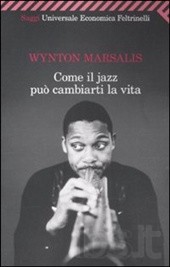
A very interesting book. It explains in depth the philosophy of playing jazz, of swing, from a great master like Wynton Marsalis, who has always been close to the great masters of this art.
The Italian translation sometimes falls short and does not read the way the English would. A shame I did not buy it in the original language.
These are my notes:
"But art means engaging with the world, not just the world around you but the larger world, and I am not talking about Tokyo, Sydney or Johannesburg, but the vaster world of ideas, of concepts, and of the feelings of history and of humanity."
"[Jazz] is the art of negotiating variations with style. [...] producing together and being together."
"Jazz is the art of timing. Real time (the cold, relentless passing of seconds and minutes), your time (how you feel real time passing) and swing time (how you adjust your time so that real time becomes our time)."
"Scientists say the only constant is change. To swing is to alter the perception of change. A musician's relationship with time can be a tremendous help in: 1) adapting to changes without losing your balance; 2) mastering moments of crisis with a clear mind; 3) living in the moment and accepting reality instead of forcing others to do things your way; 4) focusing on the collective goal even when your idea of the collective is not the dominant one; 5) knowing how and when to expend your individual energy."
"A jazz musician's primary goal is to create his own sound, despite the natural tendency to imitate what is already known. A journey of effort and introspection. In the end, you need the courage and the dedication to create your own way of speaking a language many do not understand. It is about testing your strength of spirit and your integrity."
"Today jazz musicians must possess an unlimited dose of personal integrity, because they are not asked to give more (professionalism, sensitivity to the music, refinement, feeling). They are asked to give ever less: something that sells easily or secures them some dubious subsidy."
"[Tony Williams] told me he had noticed that the musicians with the best time did not tap their foot when they played. Because when you tap your foot, every rhythm becomes a polyrhythm and coordination becomes a feat, like rubbing your belly and patting your head at the same time."
"At rehearsals Blakey played with the same intensity he put into concerts, and when you pointed it out he would say: I only know one way to play."
"The arts express the collective wisdom of a people. They represent both our highest aspirations and everyday life, our view of personal relationships and of spiritual questions, as well as how we face birth, death and everything in between. In short, art defines our identity and expands our knowledge of the possible."
"We are all potential artists, driven by the need to create a sense of togetherness on every occasion. The same thing that drove an elderly, bedridden Henri Matisse to strain with a long pole to draw figures on the ceiling, relying only on memory and sensation after losing his sight from years of working with too-intense colors."